
If you’re facing drug charges in Colorado, you have a right to qualified representation no matter how severe the offense.
The drug defense lawyers at Wolf Law LLC handle a wide range of drug-related cases, including drug possession and drug trafficking offenses involving six of the most heavily trafficked drugs—methamphetamine, powder cocaine, marijuana, crack cocaine, heroin and oxycodone—as well as other controlled substances.
To learn more about your options following a Colorado drug arrest, please call Wolf Law at 720-479-8574 for a free case evaluation.
Colorado’s Drug Laws and Statistics
According to the U.S. Sentencing Commission, drug offenses are the most common type of federal case; drug charges represented almost one-third of all cases reported to the commission in 2015. Of these drug offenses, nearly 90 percent involved drug trafficking charges.
Colorado’s Amendment 64 was enacted in November 2012 and allows for personal possession, cultivation, and private use of marijuana for those 21 years of age and older.
Following the adoption of Amendment 64, marijuana-related charges reduced statewide (not including Denver) by 80 percent from 2010 to 2014; and all drug charges are down 23 percent respectively. The Denver Department of Safety reported a 77 percent reduction in marijuana possession offenses from 2012 to 2014.
Today, marijuana drug possession charges are namely defined by an amount in excess of 1 ounce, which is the legal limit a person may purchase from a retail marijuana store.
Colorado Drug Schedule Classifications
Colorado state statutes and the Denver Revised Municipal Code outline laws and penalties for specific drug violations.
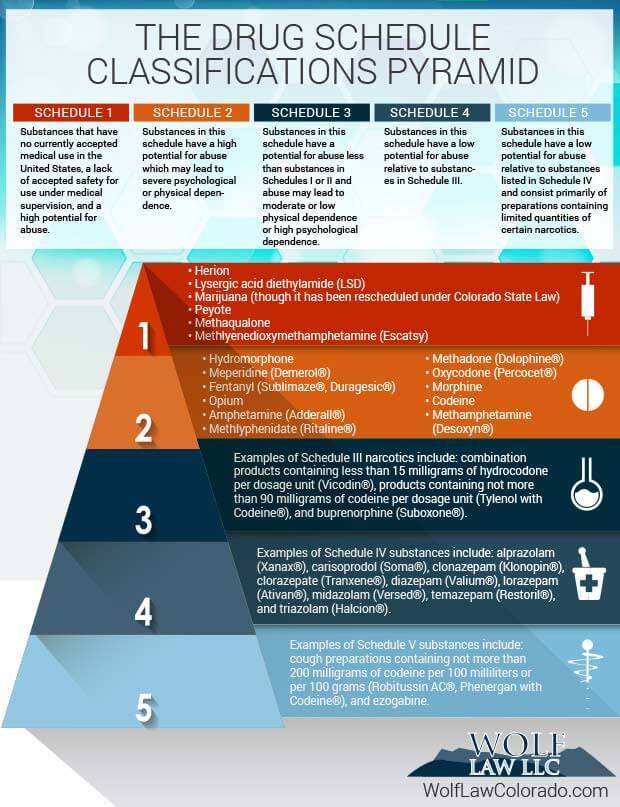
Drug classification determines how drug offenses are categorized and sentenced. Controlled substances are defined under federal drug “schedules,” which are categorized by risk of addiction:
- Schedule I drugs are considered most dangerous, highly addictive, and have “no legitimate medical use.” Schedule I drugs include controlled substances such as heroin, LSD, ecstasy, and marijuana.
- Schedule II drugs are considered addictive but may offer some redeeming medicinal properties. Common schedule II drugs include morphine, codeine, and Adderall.
- Schedule III drugs are considered less dangerous than those in schedules II and I. These drugs may include combination products like Vicodin, or non-narcotics like ketamine.
In Colorado, all drug possession charges are classified by schedule, with the exception of marijuana. Drugs like codeine, and other common pain medications, may be possessed lawfully with a valid prescription.
Types of Drug Charges in Colorado
Colorado has a variety of drug charges that range from minor offenses to severe felonies. Each charge requires a tailored approach for the best defense. Here are some common drug-related offenses in Colorado:
- Drug Possession
Possession charges depend on the type and amount of drug involved. Colorado distinguishes between personal-use quantities and larger amounts that may imply intent to distribute. - Possession with Intent to Distribute
This charge applies when someone is found with a quantity of drugs or paraphernalia that suggests distribution or sale. - Drug Manufacturing
Manufacturing charges typically apply to those accused of growing, processing, or producing illegal substances. Penalties can be severe, especially for large-scale operations. - Drug Trafficking
Trafficking refers to the transport and sale of illegal drugs and is a serious felony offense. Charges may apply at state or federal levels. - Prescription Drug Fraud
Misuse or distribution of prescription drugs, including forging prescriptions, is treated with significant legal consequences in Colorado.
Drug Laws in Colorado: What You Need to Know
Colorado’s drug laws cover controlled substances in various “schedules,” ranking from Schedule I (most dangerous and addictive) to Schedule V (lower potential for abuse). Colorado’s laws can be strict on drugs like methamphetamine, heroin, and certain prescription medications. Marijuana laws differ, as possession and use are legal in specific amounts, but penalties still apply for unauthorized distribution or large quantities.
Colorado Drug Crime Penalties and Sentencing

Convictions can bring a range of penalties depending on the charge’s severity, including:
- Fines: Minor possession charges might result in a fine, while trafficking can lead to thousands of dollars in penalties.
- Jail or Prison Time: Certain felonies carry mandatory minimum sentences.
- Probation and Community Service: Often assigned for a lesser drug offense.
- Permanent Criminal Record: Drug convictions can create significant barriers to employment, housing, and other opportunities.
Colorado drug penalties depend on the offense or act committed, the type of drug, and the drug amount. Generally, all Colorado drug cases fall into three categories:
- Petty offenses are punishable by the fine amount assigned to the offense in the Colorado Code. Petty drug offenses include things like public consumption of marijuana or illegal possession of drug paraphernalia.
- Misdemeanors are more serious than petty offenses but less serious than felonies. Drug misdemeanors are either DM1 or DM2.
- DM1: These misdemeanors are the more serious offenses. Examples of a DM1 offense include distribution, manufacturing, or possession with intent to distribute; or cultivation of less than 6 marijuana plants.
- Penalties for these offenses range from 6 to 18 months in jail and/or a fine up to $5,000.
- DM2: These misdemeanors are less serious than DM1 charges. Examples of a DM2 offense include abusing toxic vapors, use or illegal possession of synthetic cannabinoids, and possession of 2 to 6 ounces of marijuana.
- Penalties for DM2 offenses range from 0 to 12 months in jail and/or a fine up to $750.
- DM1: These misdemeanors are the more serious offenses. Examples of a DM1 offense include distribution, manufacturing, or possession with intent to distribute; or cultivation of less than 6 marijuana plants.
- Felonies are the most serious drug crimes and are punishable by lengthy prison sentences and hefty fines. In Colorado, drug felonies have four levels:
- DF1: Examples of a DF1 offense include the distribution of any amount of schedule I or schedule II controlled substances to a minor (if the adult is at least 2 years older than the minor); or the distribution of ANY material that has specific amounts of schedule I or II controlled substance combined.
- Penalties include mandatory minimum sentencing from 8 years up to 32 years and fines up to $1 million.
- DF2: An example of a DF2 offense includes the distribution of any amount of schedule III or schedule IV controlled substance to a minor (if the adult is at least 2 years older than the minor).
- Penalties include sentencing from 4 up to 8 years and fines up to $750,000.
- DF3: A level 3 drug felony might include distribution of any material that weighs 14 grams or less, and the material contains a schedule I or II controlled substance.
- Penalties include sentencing from 2 up to 4 years and fines up to $500,000.
- DF4: Level 4 drug felonies are categorized as DF3 except when distribution is for the purpose of sharing use of drugs at “a time substantially contemporaneous” with the exchange of drugs.
- Penalties include sentencing from 6 up to 12 months and fines up to $100,000.
- DF1: Examples of a DF1 offense include the distribution of any amount of schedule I or schedule II controlled substances to a minor (if the adult is at least 2 years older than the minor); or the distribution of ANY material that has specific amounts of schedule I or II controlled substance combined.
Sentencing is also determined by a range of factors that can be either “presumptive” or “aggravated.”
Presumptive sentencing is most common and the default sentencing range; however, aggravating factors, such as the offender’s criminal history, parole status, etc., may persuade a judge to apply an aggravated sentence, which favors tougher sentencing and fine requirements.
A trial by jury is available to people who are charged with a Colorado drug crime. For first- and second-time drug offenders, Colorado has implemented special “drug courts” where defendants can enter into treatment programs in lieu of fulfilling a sentence.
Common Defenses for Drug Crimes in Colorado
Wolf Law has years of experience crafting successful drug defense strategies for clients charged for drug crimes. Potential defenses include:
- Unlawful Search and Seizure
Evidence obtained illegally (without a valid warrant) can sometimes be excluded from the case, weakening the prosecution’s stance. - Lack of Knowledge
This defense may apply if the accused was unaware of the drug’s presence, often in shared spaces or vehicles. - Entrapment
If law enforcement officers encouraged or coerced someone into committing a crime they otherwise wouldn’t have, this can be a valid defense. - Lab Analysis Challenges
Challenging the identification and quantity of the substance in question can sometimes lead to reduced charges or dismissal. - Insufficient Evidence
Without clear proof of possession or intent, charges may be dismissed or reduced.
How Wolf Law Advocates for Clients Involved in Drug Crimes
At Wolf Law, we understand that drug crimes are complex and each case is unique. Our team thoroughly investigates every aspect of a case, challenges evidence, and negotiates skillfully to reduce or dismiss charges whenever possible. Our clients benefit from:
- Personalized Defense Strategies
- Transparent Communication
- Dedicated, Aggressive Representation
Why Choose Wolf Law for Your Defense?
- Denver-Based, Colorado-Focused Knowledge:
With deep knowledge of Colorado’s criminal justice system, we are ready to fight for your rights. - Proven Track Record of Success:
Our team has secured numerous favorable outcomes for clients facing drug charges, from dropped charges to minimized penalties. - Comprehensive Client Support:
Wolf Law prioritizes open, supportive communication with every client. We are here to answer questions, explain options, and offer compassionate guidance every step of the way.
Frequently Asked Questions About Drug Crime Charges in Denver
Drug crime charges can raise many questions about your rights, potential penalties, and what to expect from the legal process. The answers below address some of the concerns we frequently hear from individuals facing drug-related allegations in Denver and throughout Colorado. Understanding your options early can help you make informed decisions about your defense.
What should I do if I am arrested for a drug crime in Denver?
If you are arrested for a drug-related offense, remain calm and exercise your right to remain silent. Do not answer questions about the allegations until you have spoken with a criminal defense attorney. Anything you say can potentially be used against you later in court. Contacting a Denver drug crimes defense lawyer as soon as possible can help protect your rights and begin building a defense strategy immediately.
Are drug crimes charged as felonies or misdemeanors in Colorado?
Colorado uses a separate classification system for drug offenses that differs from standard felony and misdemeanor classifications. The severity of a drug charge depends on factors such as the type of substance involved, the amount allegedly possessed, and whether prosecutors claim there was intent to distribute. A drug crime conviction can carry significant penalties, making early legal representation important.
Can I be charged with a drug crime for possessing prescription medication?
Yes. Possessing prescription medication without a valid prescription can result in criminal charges in Colorado. This can include medications that were prescribed to someone else or medications obtained unlawfully. The circumstances of the case, including the type and quantity of the medication, may affect how the charge is prosecuted.
What is the difference between drug possession and drug distribution charges?
Drug possession charges generally involve allegations that an individual knowingly possessed a controlled substance. Distribution-related charges typically involve allegations of selling, delivering, manufacturing, or intending to distribute drugs. Distribution offenses often carry more severe penalties than simple possession charges, making it critical to understand the specific allegations being made.
Can drug charges be dismissed in Colorado?
Every case is different, but drug charges can sometimes be reduced or dismissed depending on the facts and evidence involved. Common defense strategies may involve challenging the legality of a search, questioning whether law enforcement had probable cause, disputing possession allegations, or identifying weaknesses in the prosecution’s evidence. An attorney can evaluate potential defenses based on the circumstances of the case.
Will a drug crime conviction stay on my criminal record?
A drug conviction can have long-term consequences beyond fines and potential jail time. A criminal record may affect employment opportunities, housing applications, professional licensing, and educational opportunities. Depending on the outcome of the case and the specific offense involved, some individuals may later qualify for record-sealing options under Colorado law.
What evidence do prosecutors use in drug crime cases?
Prosecutors may rely on various forms of evidence, including:
- Controlled Substances: Laboratory testing used to identify alleged drugs.
- Law Enforcement Reports: Officer observations, statements, and arrest reports.
- Search and Seizure Evidence: Items recovered during traffic stops, searches, or investigations.
- Electronic Evidence: Text messages, phone records, or social media communications when relevant.
- Witness Testimony: Statements from witnesses, informants, or law enforcement personnel.
The strength and admissibility of this evidence can be challenged depending on the facts of the case.
Can a drug charge affect my driver’s license?
Certain drug-related offenses may impact driving privileges depending on the circumstances and the nature of the charge. The potential consequences can vary significantly from case to case. An attorney can help explain any collateral consequences that may apply to your specific situation.
How can a Denver drug crimes defense lawyer help?
A drug crimes defense lawyer can review the evidence, identify constitutional violations, challenge unlawful searches and seizures, negotiate with prosecutors when appropriate, and represent you throughout court proceedings. Early legal intervention often provides more opportunities to protect your rights and pursue the best possible outcome.
When should I contact Wolf Law about a drug charge?
You should contact Wolf Law as soon as you learn you are under investigation or after an arrest for a drug-related offense. Early action can help preserve evidence, protect your rights, and allow your legal team to begin preparing a defense strategy before critical court deadlines arise. Wolf Law offers free consultations and can help you understand your options moving forward.
Get the Drug Defense Lawyer You Deserve
Everyone makes mistakes, and sometimes bad things happen to good people.
Colorado drug laws are complicated, but we can help. Knowing who to call, when to call them, and what not to say to law enforcement is the first step in building your defense if you are charged for any type of drug crimes.
Charged with a drug offense in Colorado? Understanding your charges — and your options — is the first step. Speak with a Colorado criminal defense attorney today.